
Norfolk County Parole Versus Probation
Parole and probation can both require a person to report in the community, follow set rules, and return to court or custody after a serious violation. Their legal sources differ. The Massachusetts Parole Board decides parole, which is conditional release from a jail or prison sentence. The sentencing court imposes probation, and the Massachusetts Probation Service administers it. A person released from the Norfolk County Correctional Center or a Massachusetts Department of Correction facility may have one, both, or neither. A release record should identify the route instead of leaving it to guesswork.
The distinction matters because Massachusetts has no open statewide name search for every parolee or probationer. A parole hearing or decision may document the Board's action. A MassCourts docket may show that probation was imposed. Neither source is a full live-supervision roster.
| Point | Parole | Probation |
|---|---|---|
| Source | Conditional release by the Parole Board | Court-ordered sentence or sentence part |
| First public record | Published hearing calendar or decision when available | Public sentencing and disposition entries |
| Current verification | Assigned regional parole office | Sentencing court probation office |
| End point | Discharge or expiration of parole supervision | Completion or court termination of probation |
- Parole
- Release into the community under Board conditions before the sentence fully expires.
- Probation
- Court supervision served in the community, sometimes after custody and sometimes instead of it.
- Discharge
- The formal end of custody or supervision, shown by the responsible agency's record.
- Absconder
- A person officially alleged to have left supervision or failed to report, not someone who merely fails to appear in a public search.
Check Norfolk County Release Supervision
Start with the release type. Norfolk County jail records belong to Sheriff Patrick W. McDermott's Norfolk County Sheriff's Office, while state-prison release records belong to MADOC. A Board decision proves a parole outcome but may not prove a physical exit. Conditions, a release plan, a detainer, rescission, or later processing can delay departure. For probation, the court docket can prove what the judge ordered, but live reporting details may be confidential.
- Obtain the NCSO or MADOC release transaction and identify parole, probation, expiration, or transfer.
- Search the MassCourts public case system for the disposition, sentence, probation term, and public warrant entries.
- For parole, check the Board's hearing and decision sources by name and commitment number. Record the decision date and exact outcome.
- For probation, identify the sentencing court and ask its probation office what may be verified under access rules.
- Confirm the actual custody exit with the agency that held the person. A grant or sentence entry alone is not a release timestamp.
Massachusetts probation officers generally cannot disclose an adult's current reporting status to friends, relatives, or other concerned people without the person's signed release. The individual can seek their own record through the assigned officer, subject to review and redaction. Limited notification rules can apply in specified cases. The most accurate public statement may therefore be that probation was ordered, not that the person is presently compliant.
Note: A blank public search does not prove that Norfolk County parole or probation ended, or that a warrant exists.
Norfolk County Probation Court Routes
The right probation office follows the criminal case, not a single countywide name index. Brookline District Court serves Brookline. Dedham covers Dedham, Dover, Medfield, Needham, Norwood, Wellesley, and Westwood. Quincy covers Braintree, Cohasset, Holbrook, Milton, Quincy, Randolph, and Weymouth. Stoughton covers Avon, Canton, Sharon, and Stoughton. Wrentham covers Foxborough, Franklin, Medway, Millis, Norfolk, Plainville, Walpole, and Wrentham. Norfolk Superior Court handles countywide Superior Court criminal matters.
Use the municipality and docket number to locate the case. Then contact that court's probation office. Public disposition entries can show a probation term, no-contact order, later review, or public warrant notation. Current compliance remains subject to court access rules. This split across five District Court territories and Superior Court is why a general Norfolk County probation search can miss the proper office.
Norfolk County Parole Hearing Records
The Parole Board's Life Sentence Hearing Calendar is a rolling monthly list, not a complete schedule of all institutional hearings. A calendar may give a hearing date, commitment name and number, hearing type, and a note such as postponed. Ordinary institutional release, rescission, and revocation hearings at prisons and houses of correction are generally closed. Public life-sentence hearings and certain termination proceedings follow separate Board rules.
Published Life Sentence Records of Decision can include the hearing date, decision date, Board vote, reasons, outcome, and review interval. A grant can still depend on an approved plan, program placement, interstate arrangement, future date, or cleared detainer. Denial means parole was not granted. Deferral moves the matter. Rescission reconsiders a prior favorable action. Revocation concerns someone already on parole. The official life-sentence hearing calendar can be viewed before attending or relying on a date.
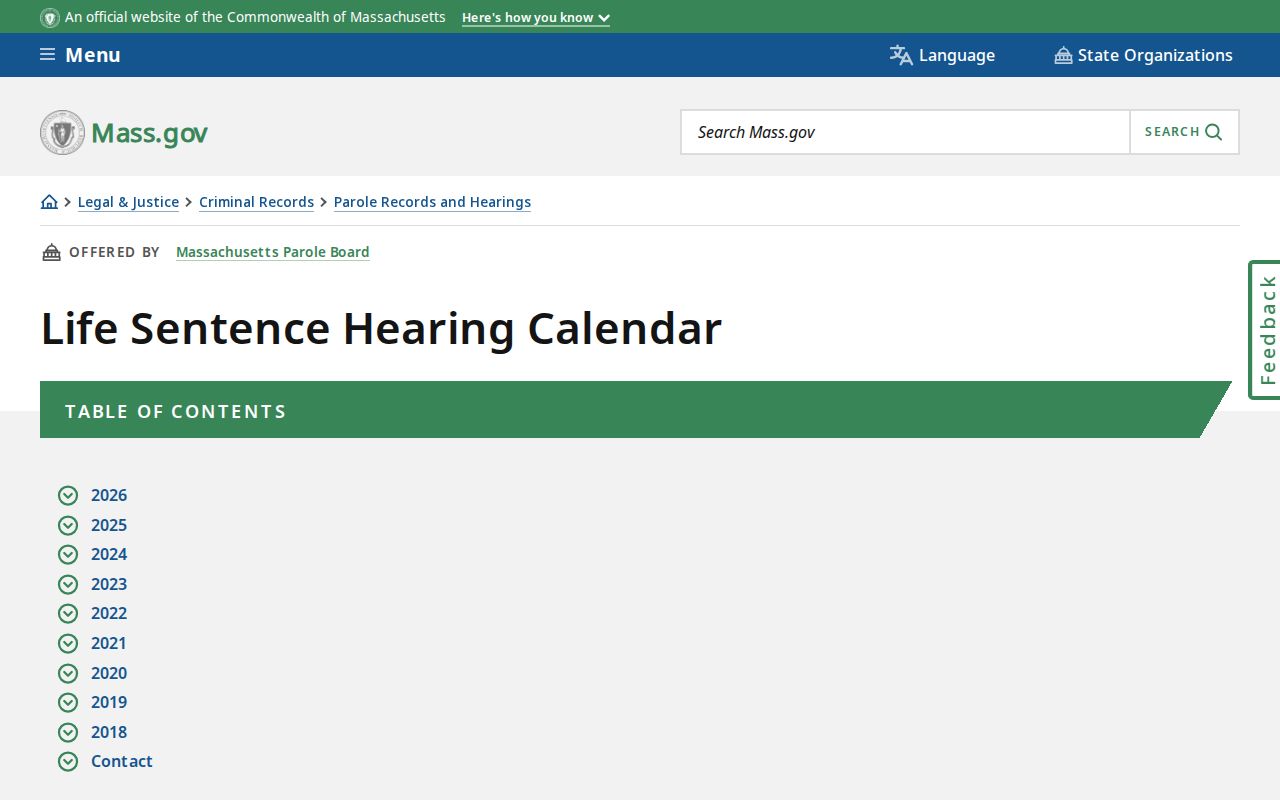
Its monthly structure helps locate a public proceeding, but it is not proof that a Norfolk County prisoner was released.
Norfolk County Parole Contacts
The Board's central office handles public Board information and hearing resources. Field supervision is assigned by residence and case, not simply by the county where a prison stands. Region 7 in Brockton may serve a case, but it should not be assumed for every Norfolk County release. The listed Norfolk County House of Correction institutional officer is a pre-release route, not a public locator for someone already in the community.
Massachusetts Parole Board
12 Mercer Road
Natick, MA 01760
508-650-4500 or 866-480-6272
Monday through Friday, 8:45 a.m. to 5 p.m.
Region 7 Reentry Center
231 Main Street, second floor
Brockton, MA
508-587-0987
Confirm assignment before relying on this office.
For an NCSO institutional matter, the May 2026 directory lists the institutional parole officer at 781-751-3353 and office support at 781-751-3351. A released person's assigned field office may be elsewhere.
Norfolk County Supervision Warrants
No public Norfolk County or statewide parole-and-probation absconder list was identified. The Parole Board operates a Warrant Apprehension Unit, and public court entries may show a warrant in a probation case. Under Massachusetts law, parole violation or temporary-custody warrants can lead to arrest, return to custody, and changes in sentence time. Those effects require a current official record.
Do not infer absconder status from a missing VINELink result, an old article, or a person who does not appear in a public decision list. VINELink reports participating MADOC custody data, not compliance with probation or every parole condition. Verify a warrant with the court, Parole Board, or responsible law-enforcement agency and note when the information was checked. A rescission record can show that a parole date was reconsidered, while a revocation record concerns a parole permit already in force.
Note: Norfolk County supervision status and warrant status are separate facts, and each needs its own current official source.
Norfolk County Reentry After Release
NCSO reports that reentry planning begins with a team meeting within 72 hours of arrival and a working Transition Plan. That process can address expected needs before release. The local H.O.P.E. Center operates in Braintree and Quincy through appointments. Its navigation may include help with state identification or a driver's license, health-insurance access, treatment referrals, and peer recovery coaching.
These services can support someone on probation, parole, or no supervision at all. Participation is not proof that the person left custody, and it does not disclose supervision status. A Norfolk County release still requires the NCSO or MADOC transaction. The court or Board record then identifies any formal supervision. Reentry help addresses the practical work that comes after that legal event. The H.O.P.E. Center's official service information is shown in the captured source.
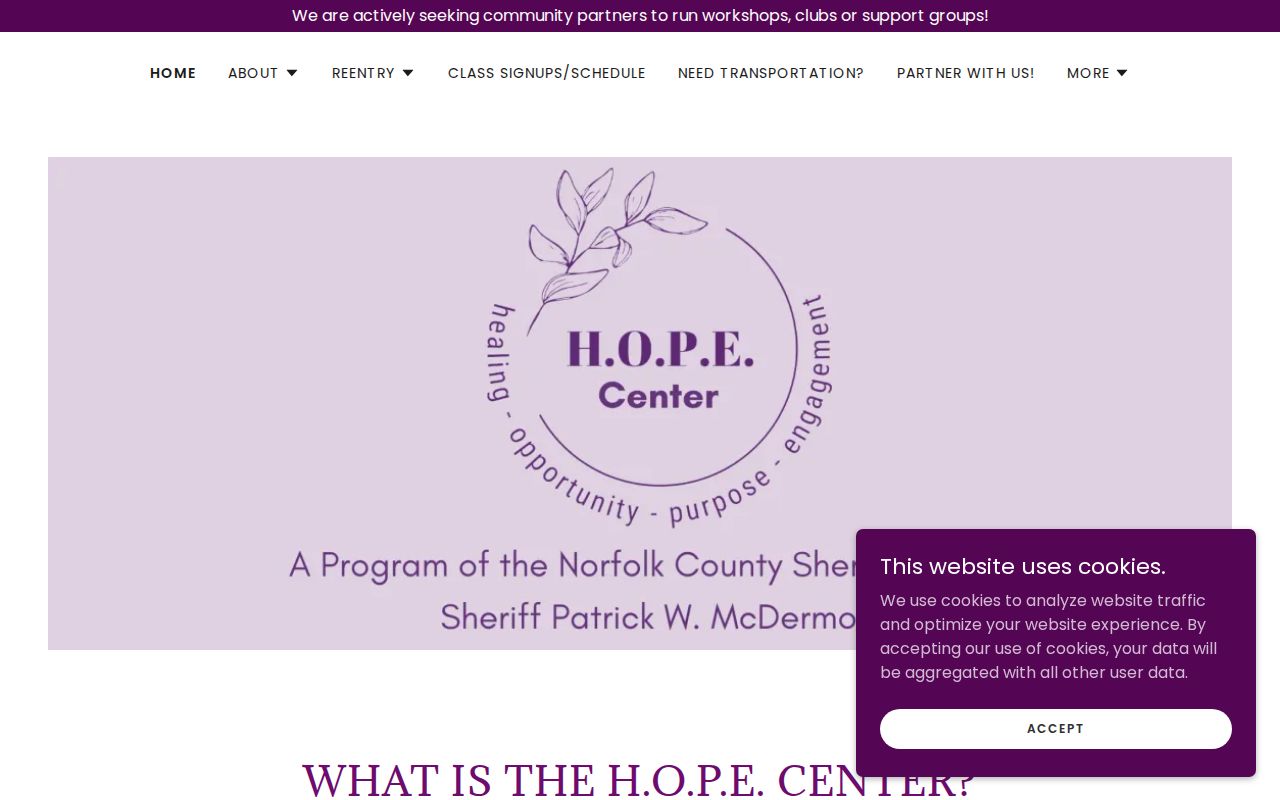
The source confirms a local navigation channel, not a custody or supervision lookup.
Property After Norfolk County Release
A person released directly from court may leave belongings at the Norfolk County Correctional Center. The Sheriff's current property page says pickup is available Monday through Friday from 9:30 a.m. to 2:00 p.m. with identification and intake paperwork, and that unclaimed property may be disposed of after 60 days. An older jail FAQ gives a later closing time and a 30-day period, so call 781-329-3705 before traveling.
If the owner is held at another institution, NCSO says a notarized designation is needed. Property pickup is a practical post-release task, not proof of probation, parole, or discharge. Use the custody transaction for release and the court or Board source for supervision. The full Norfolk County release-search and record path is available from the Norfolk County released inmates search.
Norfolk County Supervision Discharge
Supervision ends through the authority that created it. A parole discharge or expiration belongs in Parole Board and release records. Probation ends under the court's order, after completion or another lawful termination. Custody discharge is different from supervision discharge. Someone can leave jail or prison yet remain on parole or probation, while another person can complete a sentence without either form.
Keep the documents in order: custody release transaction, parole decision or court sentence, current verification from the assigned office when disclosure is allowed, and final discharge or termination record. That chain answers both when the person left custody and whether supervision continued. It also avoids treating a hearing grant, projected date, or old docket entry as proof of current Norfolk County post-release supervision.